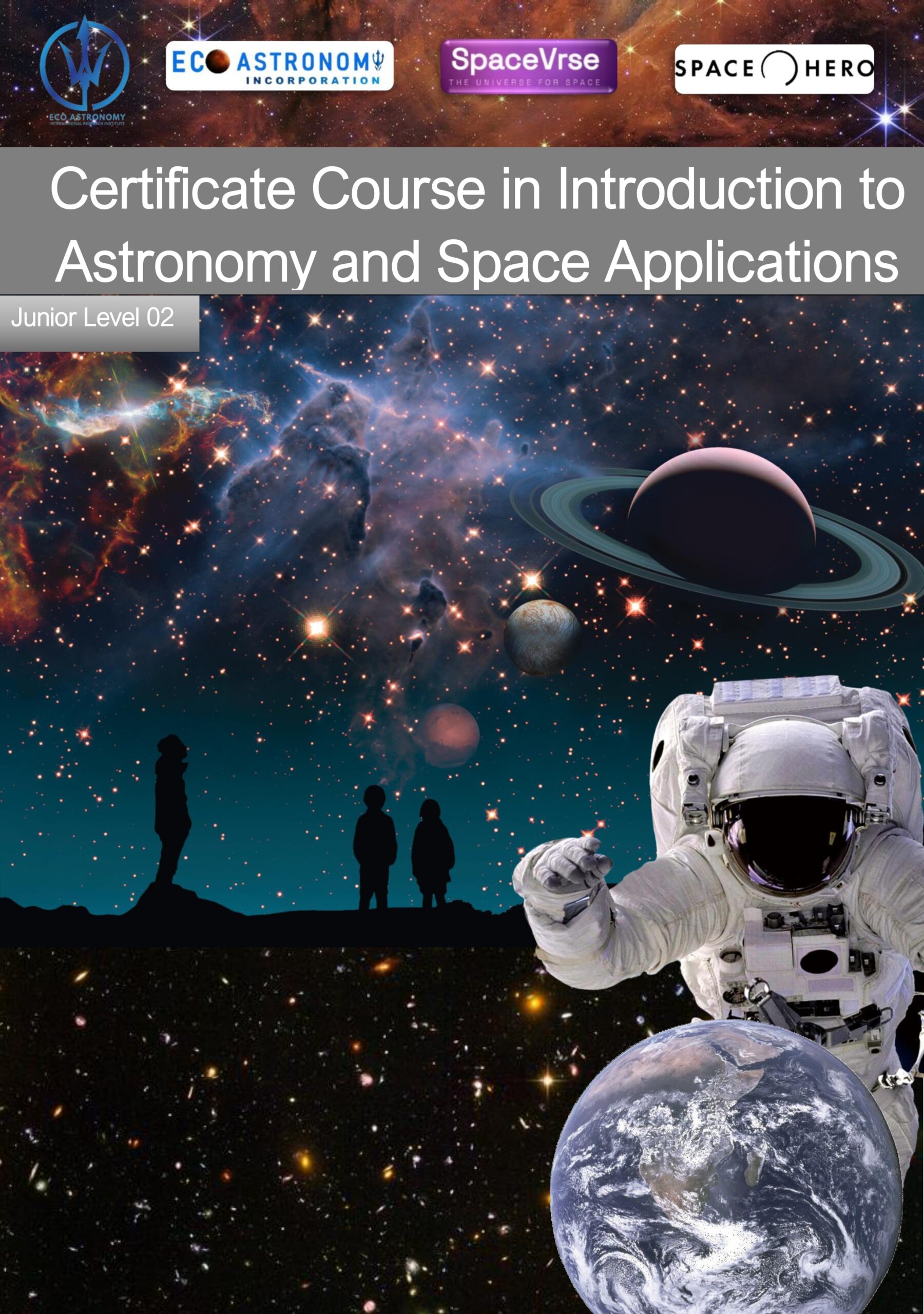
Certificate Course in Introduction to Astronomy and Space Applications | Junior Level 02 | Batch 01 | 2026
Solar system
Life beyond the planet earth
Exoplanet
Meteorites
Certificate Course in Introduction to Astronomy and Space Applications
COURSE TYPE: Short Certificate | MODE: Physical learning only
COURSE HOURS: 30
CODE : SECEDA/R/Eh/026
Course Instruction |
The Certificate Course in Introduction to Astronomy and Space Applications (Junior Level 02) is organized and conducted by Eco Astronomy Inc., an officially registered institution in Sri Lanka dedicated to astronomy education, scientific research, and space outreach. Eco Astronomy Inc. maintains official collaborations with international institutions involved in Astrobiology and Paleontology research. The institution has contributed significantly to scientific preservation by safeguarding more than 500 fossil specimens discovered in Sri Lanka. In addition, the Mars Regolith Simulant (Artificial Martian Rocks) developed by Eco Astronomy Inc. has been supplied to the Mars Desert Research Station (MDRS) of The Mars Society (USA) and Protoplanet India for research and educational purposes.
The institution is also registered in the Global Research Identifier Database / Research Organization Registry (ROR), an internationally recognized research organization identification system. Furthermore, Eco Astronomy Inc. is an official member of the international space outreach initiatives SpaceVrse and Space Hero. As part of our commitment to promoting astronomy and space science education in Sri Lanka to international standards, this course is conducted exclusively in the English medium. Please note that, in accordance with the official request received by our institution and the scientific community supporting this initiative, only students enrolled at ABC Preschool and Daycare Center (Registration No. SECEDA/R/Eh/026) are eligible to participate in this course.
The program is delivered through in-person (physical) classroom sessions only, ensuring an engaging and hands-on learning experience. The course will be conducted over 20–30 instructional hours, incorporating practical activities, demonstrations, and a final student presentation. Dr. Majda Aouititen will serve as the Examination and Education Counselor for the program. The course will be coordinated by Aravinda Ravibhanu, Chief Executive Officer (CEO), Research Scientist, and Ambassador at The Mars Society.
Following the successful completion of all practical activities and the final presentation, the official results of all participants will be published on the institution’s official website. In addition to the primary course certificate, students will have the opportunity to earn an additional certificate through the Open Science Training Program, which is offered as an enrichment activity within the course.
Course Structure & Breakdown |
Module 1: Looking Up at the Sky (4 Hours)
Focus: Day and night, the Sun, the Moon, and stars.
Session 1.1: Day vs. Night (2 Hours) : What is in our sky during the day? (The Sun, clouds, birds). : What comes out at night? (The Moon and stars). : Activity: “Day and Night” shadow puppet show or drawing activity.
Session 1.2: Twinkle, Twinkle, Little Star (2 Hours) : What are stars? (Big balls of glowing gas, like our Sun). : Connecting the dots: Introduction to simple constellations (The Big Dipper/Orion overview). Activity: Glow-in-the-dark star sticker mapping on dark paper.
Module 2: Our Cosmic Neighborhood – The Solar System & Formation (6 Hours)
Focus: The Sun, planets, and Earth’s special place in space.
Session 2.1: Meet the Sun and the Inner Planets (2 Hours) : The Sun as the center of our solar system (star power!). Mercury, Venus, Earth, and Mars: The rocky planets. Activity: Finger painting or modeling clay planets (focusing on Mars and Earth).
Session 2.2: The Gas Giants and the Outer Worlds (2 Hours) : Jupiter, Saturn, Uranus, and Neptune: The big, stormy, and icy planets. Saturn’s beautiful rings. Activity: Creating Saturn rings using paper plates and glitter.
Session 2.3: Earth – Our Spaceship Home (2 Hours) Why can we live on Earth? (Water, air, and the right temperature). : The Moon as Earth’s natural satellite and its changing shapes (phases of the Moon using cookies/Oreos).
Module 3: Space Travel & Technology (6 Hours)
Focus: Rockets, astronauts, and how we study space.
Session 3.1: Rockets and How They Fly (2 Hours) : Action and reaction: How do rockets blast off into space? : Activity: Balloon rocket experiment (using string, a straw, and a balloon to demonstrate propulsion).
Session 3.2: Life as an Astronaut (2 Hours) : What do astronauts wear? (Spacesuits and helmets). : How do astronauts eat, sleep, and float in zero gravity? : Activity: Design your own astronaut badge and spacesuit coloring sheet.
Session 3.3: Tools of the Astronomer (2 Hours) : Looking closer: Telescopes and space observatories. : Looking down from above: Weather satellites and how they help us on Earth. : Activity: Make a simple cardboard spyglass/telescope.
Module 4: Young Space Explorers Showcase (4 Hours)
Focus: Review, teamwork, and creative expression.
Session 4.1: Mission Control Project (2 Hours) : Group collaborative project: Building a model Solar System mobile or a large cardboard rocket ship.
Session 4.2: Space Quiz, Assessment, Presentation & Examination, (6 Hours)
Teaching Methodology: Visual & Kinesthetic Learning: Heavy use of colorful space videos, scale-model representations, songs, and physical movement. Fun, gamified trivia review of what we learned NASA STEM Gateway, ESA PAXI Art Work.
Storytelling: Explaining complex cosmic phenomena through relatable fables and adventures.
Safe Experimentation: Utilizing everyday classroom materials (balloons, paper, yarn, cardboard) for hands-on physics and astronomy concepts.
Assessment Methods |
Formative Assessment: Continuous observation during hands-on activities, participation in discussions, and enthusiasm during group tasks. Summative Assessment: An interactive, low-stress oral quiz game during the final session and completion of the group project.
Awarding of the Certificate Course in Introduction to Astronomy and Space Applications | Junior Level 02.
Important Notice
Due to the exceptionally high number of registrations, enrollment for the NASA Open Science Essentials Program has been temporarily suspended effective 16 July 2026. However, the NASA STEM Gateway remains open to all students, providing access to future educational opportunities and upcoming NASA-related programs. Additional information regarding these opportunities will be shared with participants during the course.
Examination Results Section 01 | Available
Examination Results Section 02 | Pending
Day 01 Student Involvement Tasks | Batch 01 | Available
Day 02 Student Involvement Tasks | Batch 01 | Available
Contact info: 0774526520 | +94114216868 |
Email : Info@ecoastronomy.edu.lk | hr.ecoastronomy@gmail.com
